Mean Collapse is a Serious Bottleneck of VLA
TL;DR
On OGBench AntMaze-medium we train a VLM-based VLA (Qwen3-VL 2B) under two cameras and two heads: top-view (MDP) coordinate-VQA and 3rd-person (POMDP) direct action. Both mean-collapse, but the bare top-view collapses to 0%: the ant tips over, twitches, freezes.
The cause specific to VLM-based VLAs is ViT-level feature aliasing. The ant covers a few pixels in top-view, ViT patches are nearly constant across the episode, and the LLM sees the same input every step. Higher-resolution top-view fixes it. The coordinate-VQA reformulation also works: top-view recovers to 0.53.
A small memory-based steering module (GLA Linear-SSM + Perceiver) on the frozen 3rd-person VLA lifts success from 0.16 → 0.84, close to the 0.91 we get with both cameras + VQA, even though steering uses only the 3rd-person input that would be available in the real world. The same Markovian-on-$o_t$ failure shows up on a GUI agent (GELab-Zero) looping C → D → E → C → D → E → … on a Duolingo quiz.
1. MDP vs. POMDPWhy Mean Collapse Happens
A policy that reacts only to the current observation is optimal in an MDP but suboptimal in a POMDP, where the best it can do is a posterior-weighted average of conflicting actions. That average is mean collapse.
An MDP gives the agent the state directly: $\pi^{\star}_{\mathrm{MDP}}(a_t \mid s_t)$. A POMDP only gives observations $o_t \sim \Omega(\cdot \mid s_t)$, so the optimal policy must condition on history $h_t = (o_0, a_0, \ldots, o_t)$:
$$\pi^{\star}_{\mathrm{POMDP}}(a_t \mid h_t).$$
1.1 Why Mean Collapse Happens
A VLM-based VLA trained to act on the latest observation only learns $\pi(a_t \mid o_t)$. When several states alias to similar observations ($s^{(1)} \neq s^{(2)}$ but $o^{(1)} \approx o^{(2)} \approx o$), the loss is minimized by the posterior-weighted average:
$$ \pi^{\star}(a \mid o) \;=\; \sum_{i} p\!\left(s^{(i)} \mid o\right)\, \pi^{\star}\!\left(a \mid s^{(i)}\right). $$
When per-state optima point in opposite directions, the average is a degenerate output: a near-zero motion, a sideways drift, an oscillation. That is mean collapse, and on Ant-Maze it appears even on the privileged top-view input (Section 6).
2. Most VLA Benchmarks Hide the POMDP
Popular VLA benchmarks are effectively MDPs, so they never stress the POMDP regime where mean collapse appears.
LIBERO, SIMPLER, UI-TARS all assume $\pi(a_t \mid o_t)$ suffices: the current scene already encodes the task-relevant state. Real long-horizon tasks (Minecraft, GUI agents, occluded manipulation) need history $h_t$. Crafting a pickaxe needs “I already chopped a tree”, which is not in the current screen.
3. A Controllable POMDP in OGBench Ant-Maze
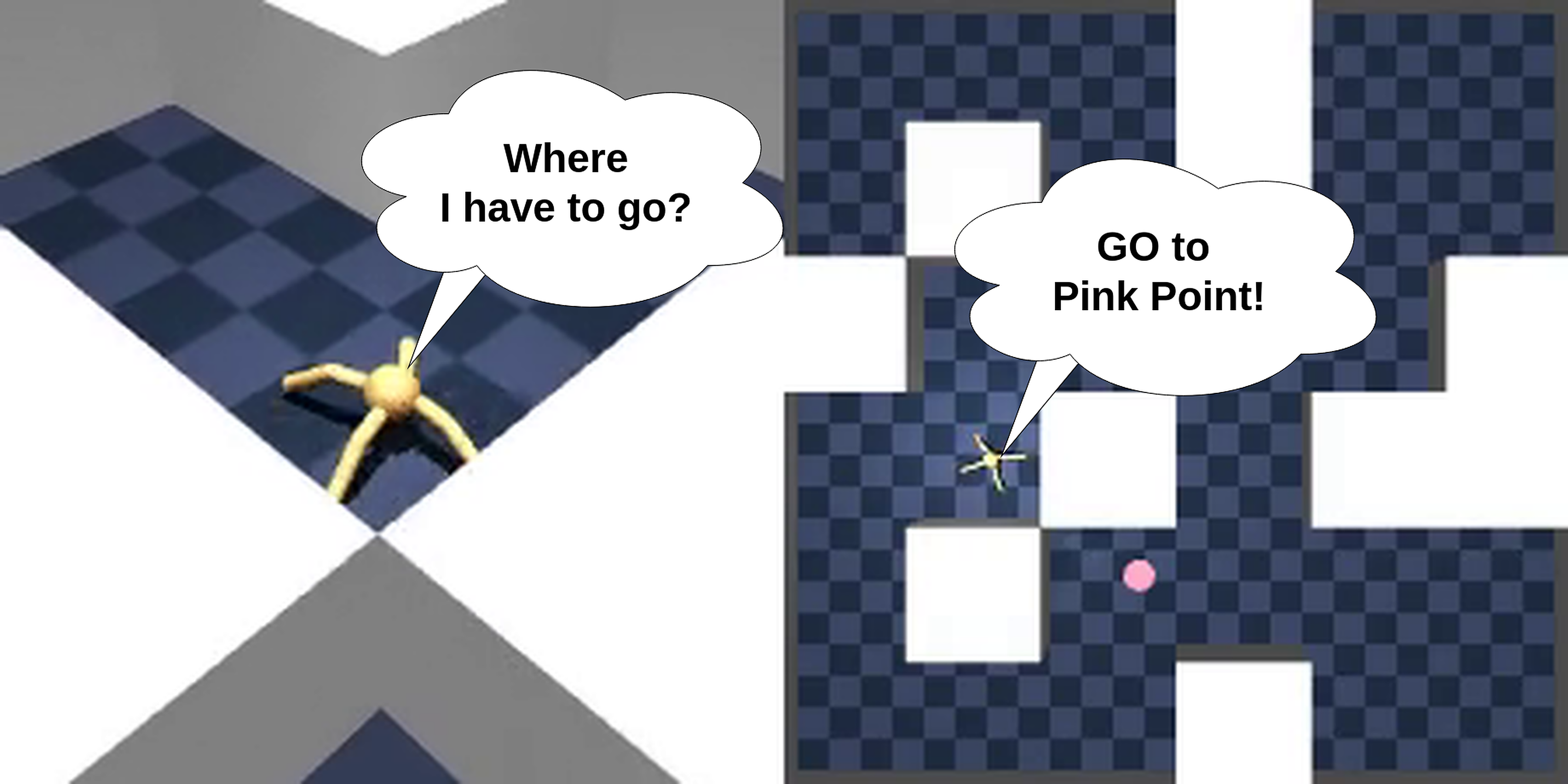
We re-render OGBench Ant-Maze in MuJoCo with two cameras. The only thing that differs across our settings is observability:
- Top-view (MDP). $o_t = s_t$, the full layout in one bird's-eye image.
- 3rd-person (POMDP). $o_t \sim \Omega(\cdot \mid s_t)$, only what is in front of the ant.
 Same world, two views. Left: top-view (MDP). Right: 3rd-person (POMDP).
4. Setup
One Qwen3-VL 2B backbone, two camera/head settings, and about $985{,}000$ goal-conditioned samples from AntMaze-medium.
4.1 Data
- OGBench
antmaze-medium-navigate-v0re-rendered through MuJoCo. - $1{,}000$ episodes $\times \sim 1{,}001$ steps, $224 \times 224 \times 3$, two cameras.
- $8$-DOF torque, qpos $15$-D, qvel $14$-D.
- Hindsight relabeling: chunk $K = 16$, terminal-goal fraction $0.25$.
How we build the training set. At every start step of an episode we form one sample: the current image plus a goal Go to (x, y) as input, and the next $16$-step action chunk (Δqpos) as the target. The goal is set by hindsight relabeling: with probability $0.25$ it is the episode's terminal goal, otherwise it is a randomly sampled future state on the same trajectory. Sliding the start step across each $\sim 1{,}001$-step episode gives $\sim 985$ samples per episode, so $1{,}000$ episodes become $\approx 985{,}000$ (image, goal, action-chunk) examples.
Note: the dataset is large because two factors compound: the $16$-step action chunk slides over every start step, and each step draws its own random subgoal. One trajectory thus expands into hundreds of (observation, goal, action) pairs.
4.2 Two heads, one backbone
Both settings start from the same Qwen3-VL 2B backbone. They differ in observability, in the output head, and in how the backbone is trained:
- Top-view (MDP), coordinate VQA. Image + Go to (x, y) $\rightarrow$ waypoint coordinates $(x_1, y_1), \ldots, (x_K, y_K)$ as text. A small low-level controller turns waypoints into 8-DOF torques.
- 3rd-person (POMDP), direct action. Image + same instruction $\rightarrow$ a parallel-decoded $16$-step action chunk of joint-position deltas (Δqpos).
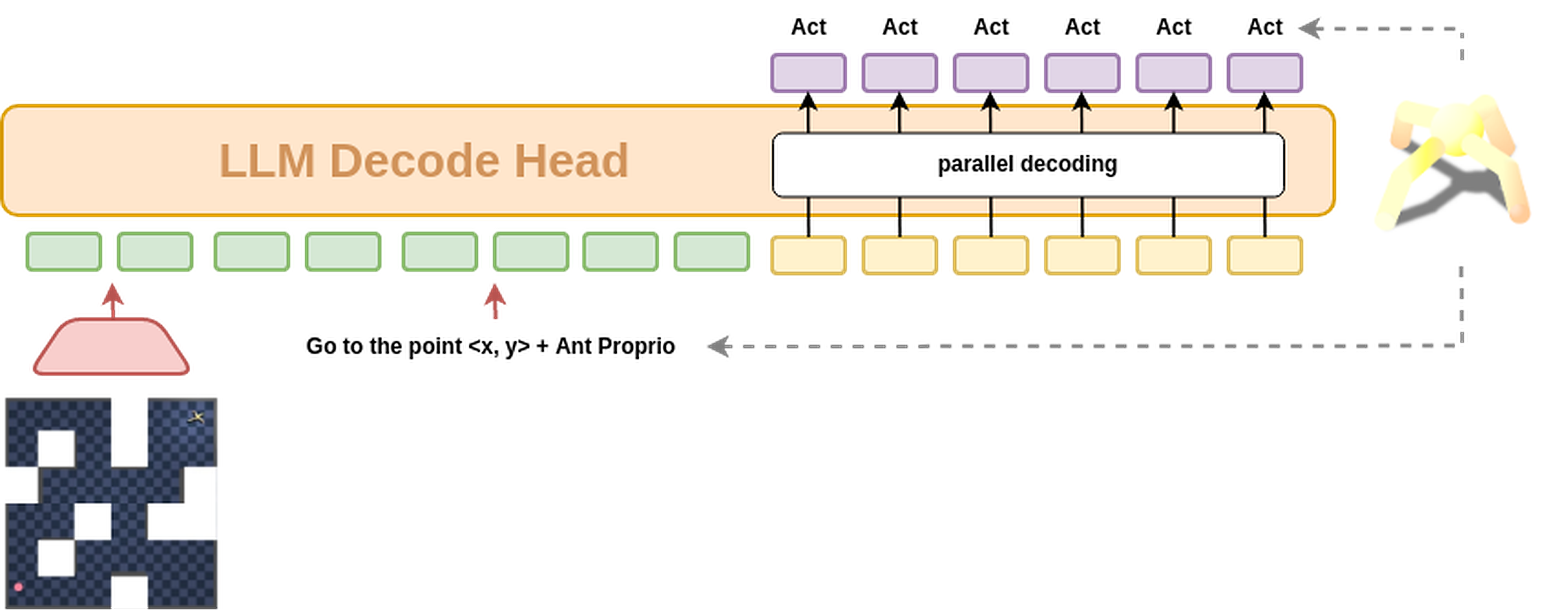 One backbone, two output heads (top-view waypoints vs. 3rd-person action chunk).
The baseline backbone. Qwen3-VL 2B is a vision-language model: a ViT vision encoder turns the image into patch tokens that feed an LLM decoder. On its own it is a chat / VQA model, not a controller.
Two training regimes. The two heads are trained differently. For the top-view coordinate-VQA head we fully fine-tune the backbone, since the model only has to emit waypoint coordinates as text. For the 3rd-person direct-action head we follow OpenVLA-OFT: a continuous action chunk decoded in parallel, learned by LoRA fine-tuning on the otherwise-frozen backbone.
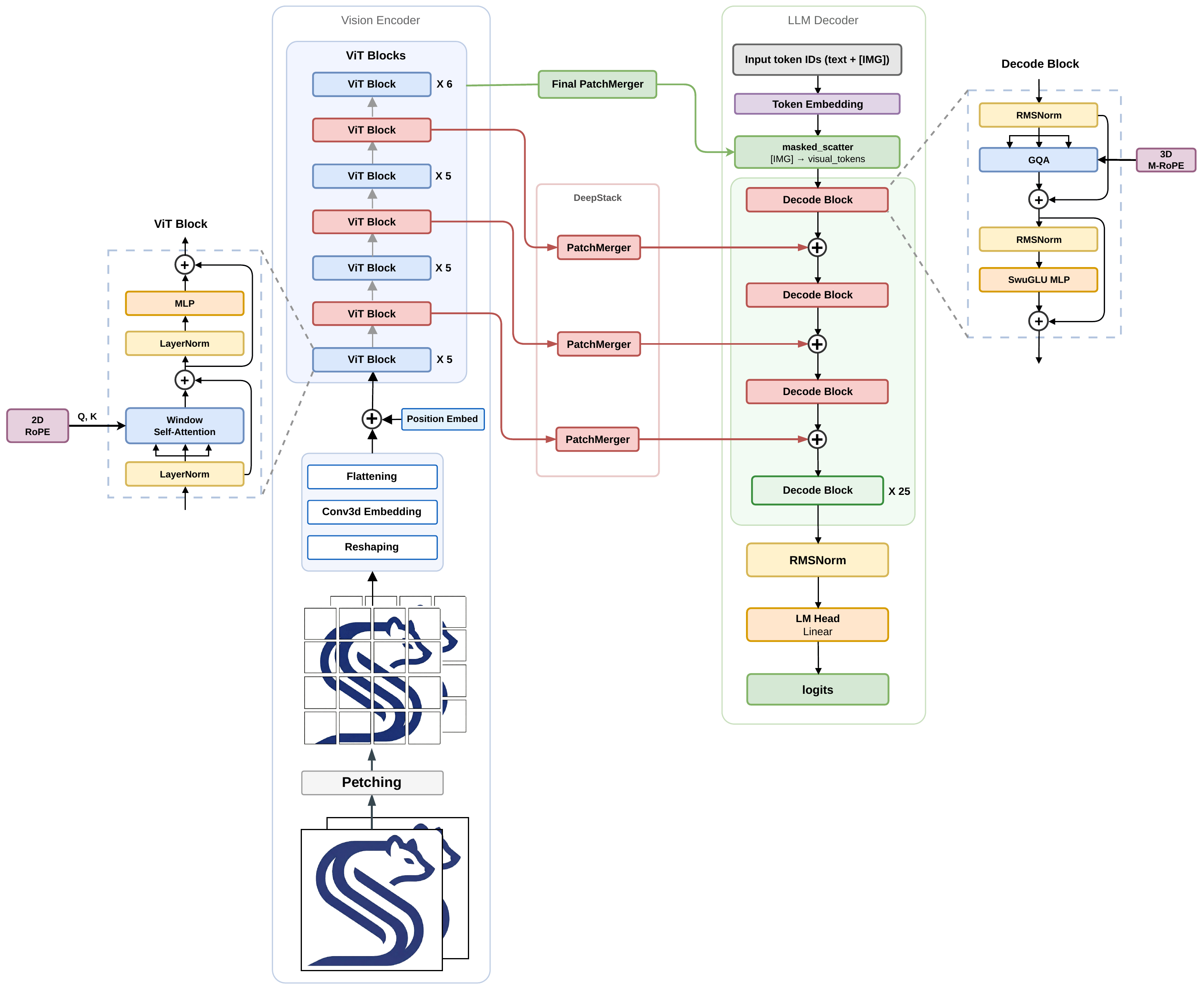 Baseline backbone (Qwen3-VL 2B): a ViT vision encoder feeding the LLM
decoder. The coordinate-VQA head is trained by full fine-tuning; the
direct-action head is trained OpenVLA-OFT-style with LoRA.
Baseline backbone (Qwen3-VL 2B): a ViT vision encoder feeding the LLM
decoder. The coordinate-VQA head is trained by full fine-tuning; the
direct-action head is trained OpenVLA-OFT-style with LoRA.
5. Both Views Mean-CollapseBare Top-View Collapses to 0%
Results at a glance (success rate): bare top-view 0.00 → with VQA 0.53 · 3rd-person 0.16 → with steering 0.84 · both cameras + VQA 0.91
The bare top-view + direct-action setting collapses to 0%: the ant tips, twitches, freezes. Only the coordinate-VQA reformulation rescues top-view (see Section 7.3 for the numbers). The 3rd-person rollouts also collapse, but the agent moves more, sometimes winning by exploration when the goal comes into view.
5.1 Top-view (MDP): different loop-case examples
5.2 Top-view: extreme stuck case
5.3 3rd-person (POMDP): opportunistic successes
6. Why the Top-View Collapse is WorseViT-Level Feature Aliasing
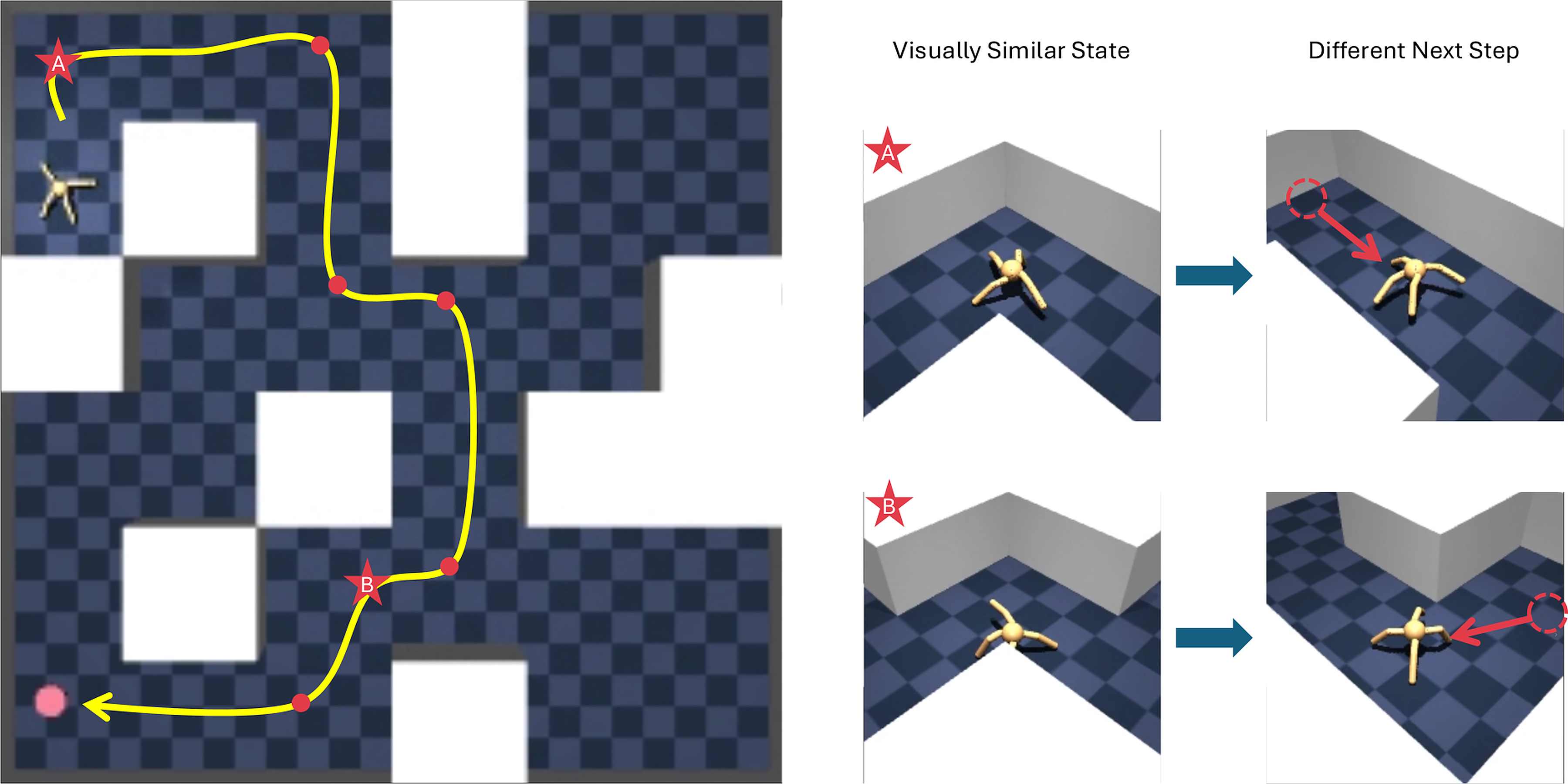
Classical mean collapse (Section 1.1) is about state aliasing in the pixel space. On the top-view that should not apply, since the state is fully visible. Yet the bare top-view collapses to 0%. The aliasing happens one level up, in the ViT feature space:
- Tiny scene-relevant region. The ant + goal cover only a few pixels; each $14 \times 14$ ViT patch sees mostly empty maze floor.
- Near-constant patch tokens across the episode. The maze layout is fixed and only a handful of pixels carry the state, so the ViT features barely change between timesteps. The LLM sees almost the same input every step.
- Broad posterior $p(s \mid \phi(o))$ over states given features $\rightarrow$ the mean-collapse identity drives the output toward a near-zero average.
- 3rd-person is the opposite: patches are filled with scene content, features change clearly between observations, and there is enough signal to commit to a direction.
6.1 Sanity check: higher-resolution top-view fixes it
If feature aliasing is really the cause, more pixels per scene should sharpen the features and reduce collapse. We confirmed this directly: feeding higher-resolution top-view images into the ViT (same backbone, same head, same prompt) recovers performance. This is exactly the "Top-view, with VQA" row in the results table (Section 7.3): 0.53, produced with the higher-resolution input. With the default input resolution the same coordinate-VQA setup also degrades; the high-res variant is the one that lands at the presentation number.
When a VLM-based VLA mean-collapses on a supposedly-MDP input, suspect resolution / feature aliasing first.
7. The FixA Memory-Based Steering Module on the Frozen VLA
A small memory module bolted onto the frozen 3rd-person VLA fixes mean collapse, lifting success from $0.16$ to $0.84$ without re-training the base model.
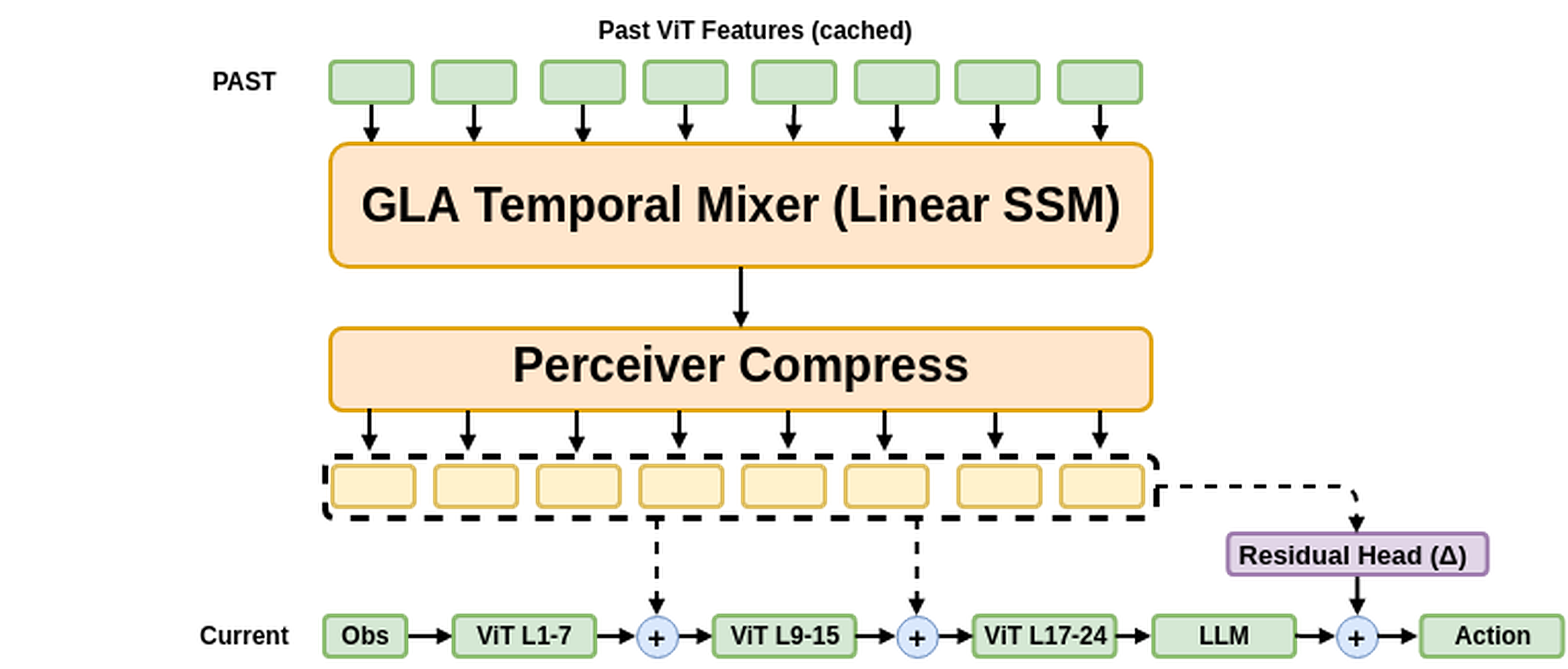 Learnable steering (peach) builds a fixed-size memory $Z$ from past ViT
features via a GLA temporal mixer + Perceiver compression, then injects
it into the frozen ViT at L8 / L16 and the action head through gated
residuals. The frozen base VLA (green) is never re-trained.
Learnable steering (peach) builds a fixed-size memory $Z$ from past ViT
features via a GLA temporal mixer + Perceiver compression, then injects
it into the frozen ViT at L8 / L16 and the action head through gated
residuals. The frozen base VLA (green) is never re-trained.
7.1 Formulation
Past ViT features $h^{(\ell)}_{t-k}$ at depths $\ell \in \{8, 16\}$ for $k = 1, \ldots, K$ are mixed by a Gated Linear Attention (Linear SSM) with content-gated decay:
$$ \begin{aligned} S_k &= \sigma(g_k) \odot S_{k-1} + K_k^{\top} V_k, \\ O_k &= Q_k\, S_k. \end{aligned} $$
The mixed sequence is compressed to $m = 32$ memory tokens by a Perceiver cross-attention with learnable queries $Q_{\text{learn}} \in \mathbb{R}^{m \times d}$:
$$ Z^{(\ell)} \;=\; \mathrm{CrossAttn}\!\left(Q_{\text{learn}},\; O^{(\ell)}_{1:K}\right). $$
Memory is injected back into the frozen ViT through gated residuals, and a small residual is added to the frozen action head:
$$ \tilde{h}^{(\ell)}_t = h^{(\ell)}_t + \sigma(\alpha_\ell)\, \mathrm{CrossAttn}\!\left(h^{(\ell)}_t, Z^{(\ell)}\right), \qquad a_t = \underbrace{\pi_{\text{base}}(o_t)}_{\text{frozen}} + \sigma(\alpha_{\text{res}})\, \Delta\!\left(Z^{(16)}\right). $$
Identity-init gates ($\sigma(\alpha) = 0$) make the module a no-op at initialization: the base VLA is recovered exactly, and only corrections are learned.
7.2 Why a State-Space Model?
- Long sequence. $T = K \cdot N_{\text{patch}} \sim 2{,}000$ tokens; $\mathcal{O}(T)$ vs. quadratic attention.
- Content-gated decay. $\sigma(g_t)$, per-token forget; more expressive than a fixed $\gamma$, more stable than plain linear attention.
- Length extrapolation. Train with $K \sim \mathcal{U}[1, 32]$; stable at $K \in \{64, 128\}$ at inference.
- Identity-init $\rightarrow$ safe to bolt onto a frozen VLA.
7.3 Results: the full picture in one table
| Setting | Camera | Output head | Success rate |
|---|---|---|---|
| Top-view, no VQA | Top-view (MDP) | Direct action chunk | 0.00 |
| Top-view, with VQA (high-res ViT input) | Top-view (MDP) | Coordinate-VQA waypoints | 0.53 |
| 3rd-person, baseline | 3rd-person (POMDP) | Direct action chunk | 0.16 |
| 3rd-person, with steering | 3rd-person (POMDP) | Direct action + steering module | 0.84 |
| Top-view + 3rd-person, with VQA | Both cameras | Coordinate-VQA waypoints | 0.91 |
7.4 Reading the table
The top number, 0.91 with both cameras + VQA, is what we got when the top-view (MDP layout) is paired with the 3rd-person view (scene-rich, high-res ViT-friendly content). Our reading: top-view supplies the MDP state, and 3rd-person supplies the kind of high-resolution patch features the ViT needs to avoid feature aliasing; the two views compensate for each other's failure modes.
The surprising part is how close the 3rd-person + steering module number (0.84) gets to the privileged-top-view 0.91. This matters because in the real world a top-view is almost never available; steering on the frozen 3rd-person VLA is the practically meaningful intervention, and the fact that the gap to a setup with the bird's-eye state is so small is the encouraging signal.
On where the remaining failures come from: most of them are not mean-collapse anymore. They are locomotion failures: the ant moves quickly mid-trajectory and tips over, after which the simulation marks the episode as failed. The mean-collapse pathology has largely been removed; what is left is a controller/dynamics issue rather than the VLA itself.
8. BonusSame Pathology on a GUI Agent
The same Markovian-on-$o_t$ failure shows up on a real GUI agent. GELab-Zero-4B-preview on a Duolingo “tap the matching pairs” quiz: solved tiles look almost identical to fresh ones, the agent has no memory of what it has tapped, so it re-taps a solved pair and the screen returns to the same state, a three-step loop:
$$C \rightarrow D \rightarrow E \rightarrow C \rightarrow D \rightarrow E \rightarrow \ldots$$
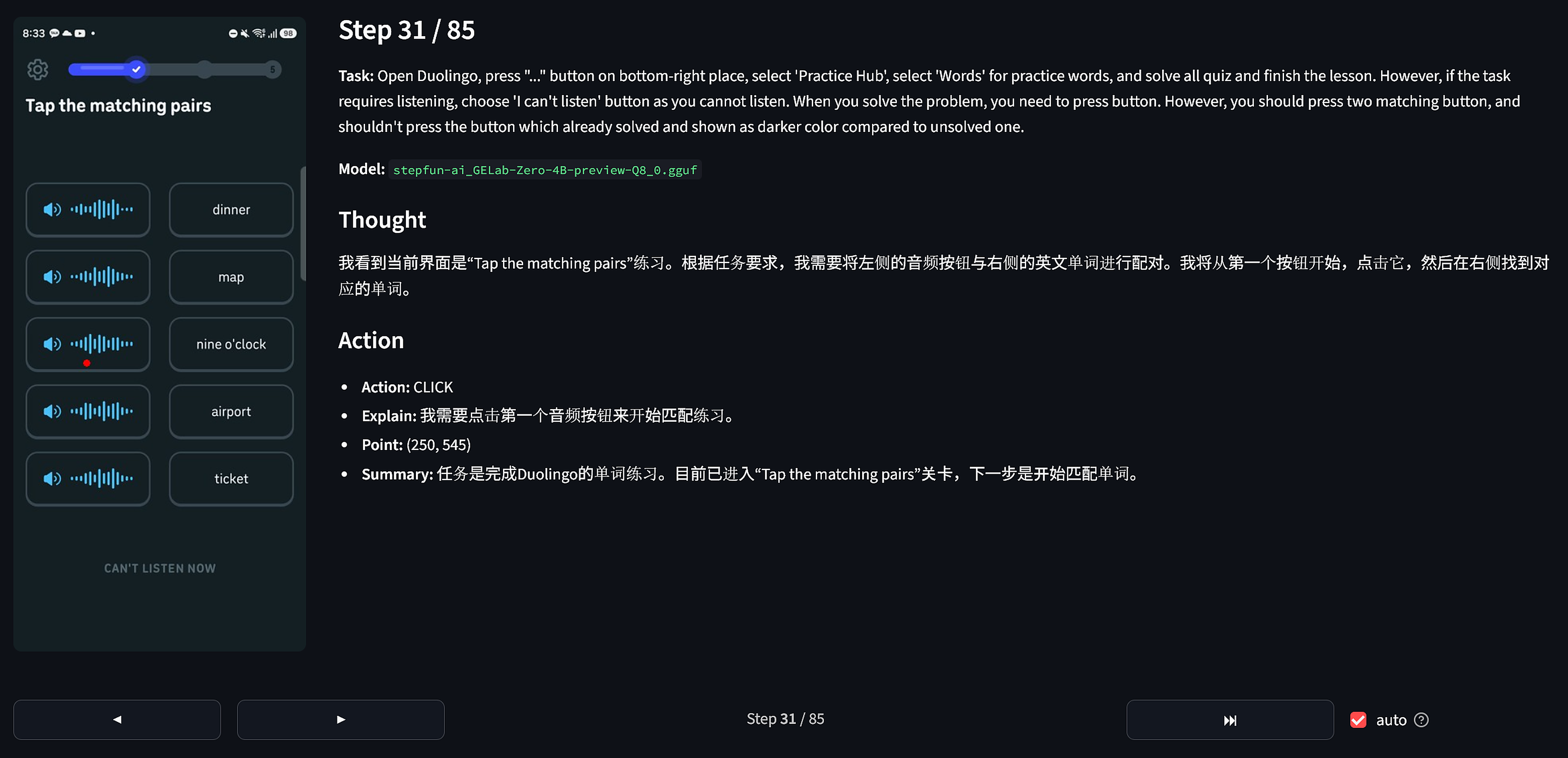 GELab-Zero-4B-preview on the Duolingo quiz:
each step it sees only the current screenshot.
GELab-Zero-4B-preview on the Duolingo quiz:
each step it sees only the current screenshot.
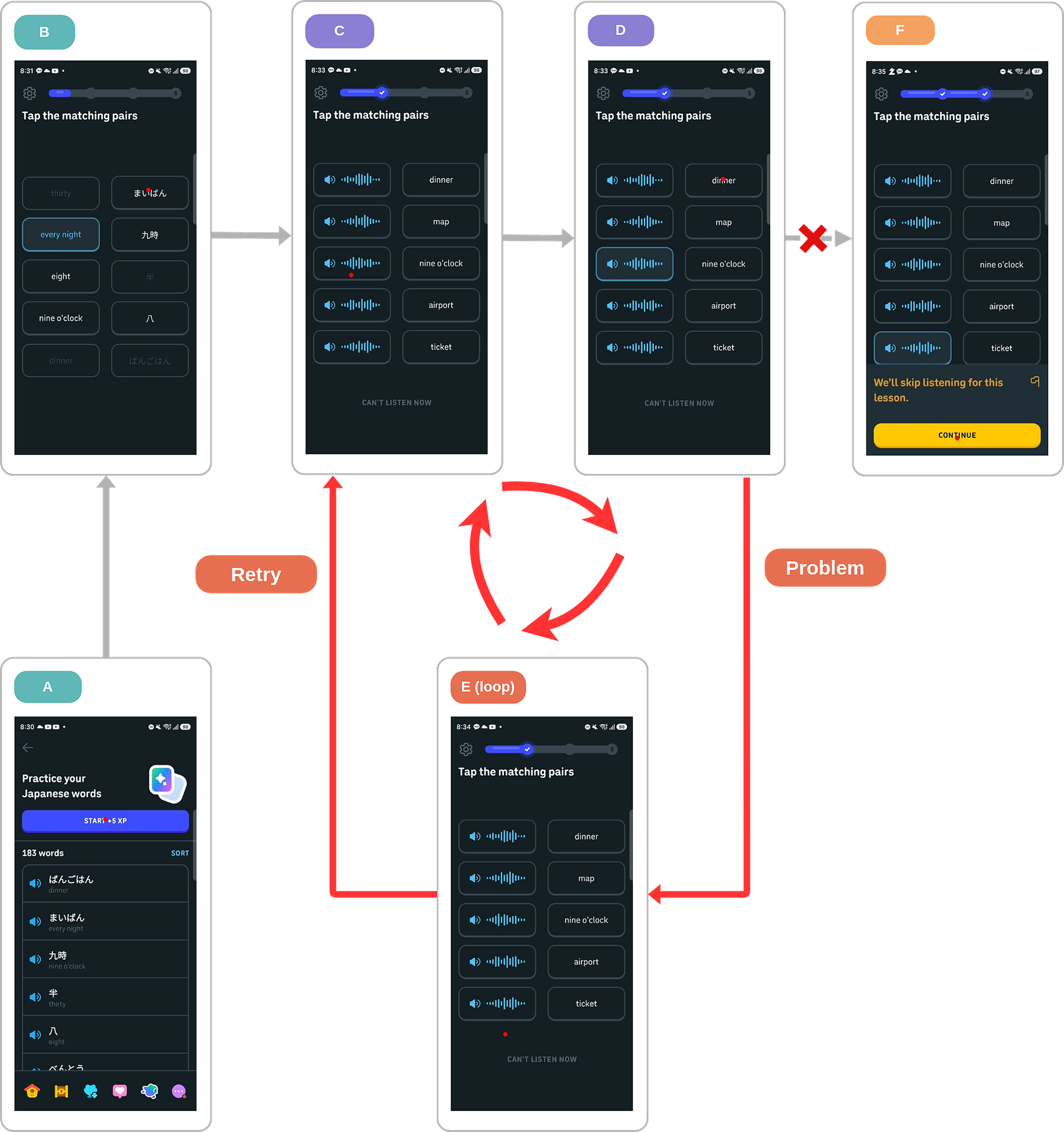 Loop-case definition: $o_t$ (screenshot) $\not\Rightarrow s_t$ (solved-set).
9. Takeaway
- Mean collapse is the bottleneck for VLM-based VLAs on the latest observation. The optimal Markovian policy is the posterior-weighted average of per-state optima, degenerate when those disagree.
- The privileged top-view does not save you. Bare top-view + direct-action collapses to 0%; the cause is ViT-level feature aliasing, fixed by higher-resolution input or by reformulating the task as coordinate VQA (0.53).
- A small memory-based steering module on the frozen 3rd-person VLA raises success from 0.16 → 0.84, close to the 0.91 we get with both cameras + VQA, even though the top-view is unavailable in the real world. Most remaining failures are locomotion-level falls, not mean collapse.
- Same pathology beyond robotics: a frozen GUI agent loops C → D → E → … on a Duolingo quiz for the same reason.
References
- Qwen3-VL: arxiv.org/abs/2511.21631
- OpenVLA-OFT: openvla-oft.github.io
- GELab-Zero: github.com/stepfun-ai/gelab-zero
- OGBench: seohong.me/projects/ogbench
Acknowledgement

This research was made possible by the TPU Research Cloud (TRC) program. We are grateful to the TRC Team and Google for providing the TPU compute that made these experiments feasible.
Sub-project of Project Weasel, maintained by Kang Minkyu.